
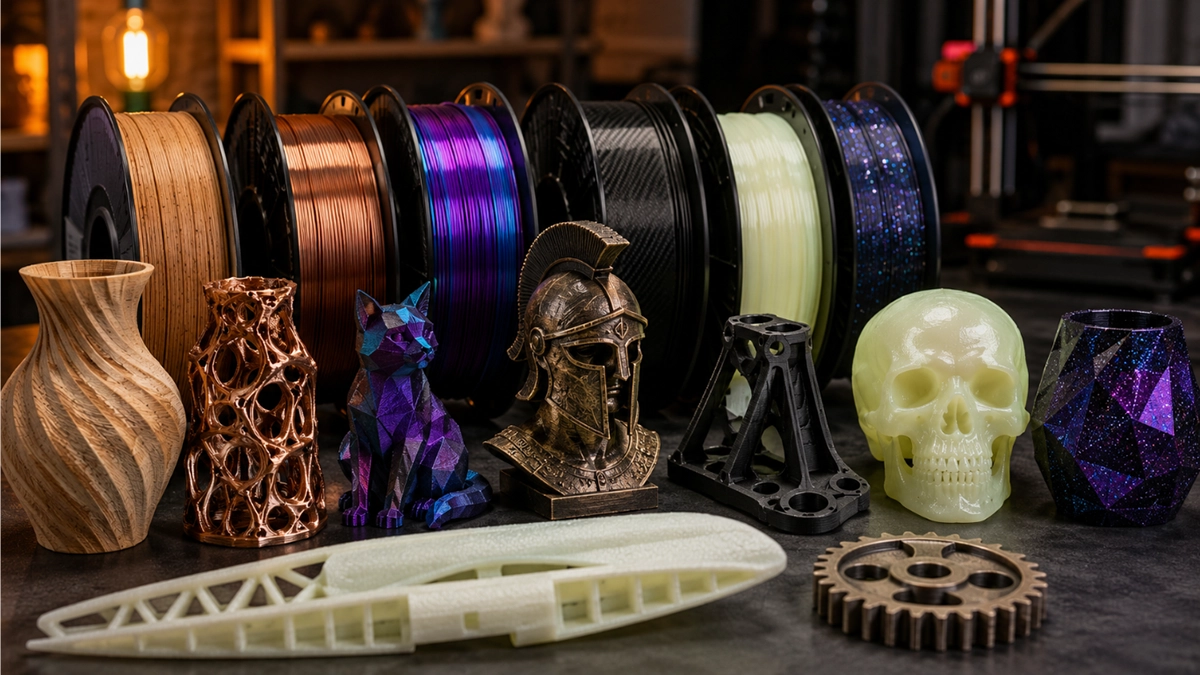
Once you’ve mastered standard PLA and PETG, it’s only a matter of time before those eye-catching spools of speciality filaments start calling your name. From realistic wood finishes and metallic effects to colour-shifting silk PLA and glow-in-the-dark creations, speciality filaments can transform ordinary prints into something truly unique.
But before you load that shiny new spool into your printer, it’s worth understanding that these materials often behave very differently from standard 3D printing filaments. While the results can be stunning, speciality filaments often require a few adjustments to your printing setup and expectations.
In this guide, we’ll explore some of the most popular speciality filaments available today, what makes them unique, how they print, and what you should realistically expect from them.
What Are Speciality Filaments?
Most standard 3D printing filaments, such as PLA, PETG, ABS and ASA, are designed to be reliable and easy to print. Speciality filaments, on the other hand, are engineered to offer unique visual effects, textures, weight characteristics, or mechanical properties that standard materials simply can’t provide.
These specialty 3D printing materials are typically created by blending a base material, usually PLA or PETG, with additives such as wood fibres, metal powders, carbon fibre, phosphorescent pigments, or decorative flakes.
The trade-off? Those same additives often make the filament more demanding to print. Some are abrasive, some are prone to clogging, and others require specific nozzle sizes or temperature settings.
Let’s take a closer look at some of the most popular options.
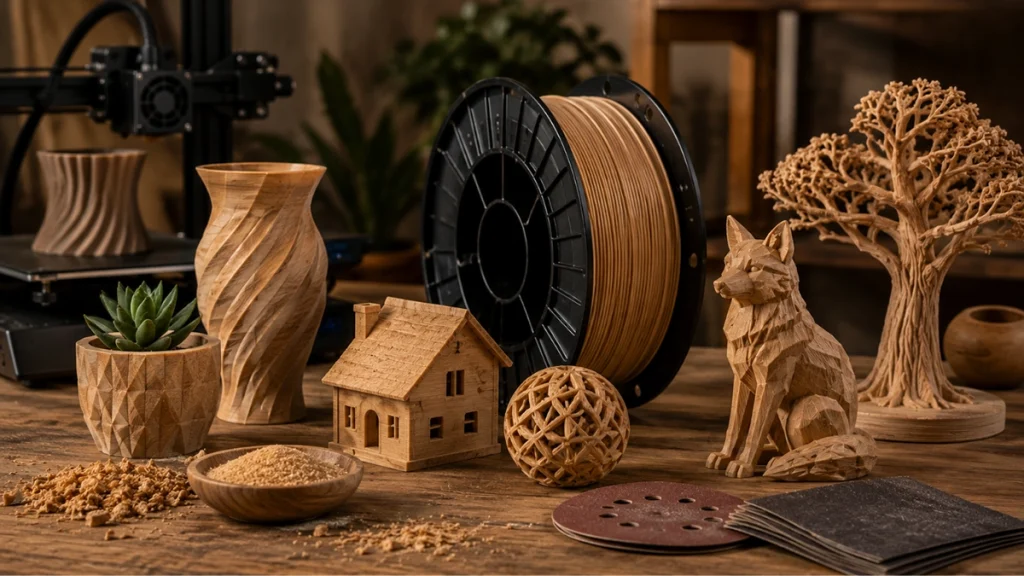
Wood-Fill PLA: Bringing Nature to Your Prints
What Is Wood Filament?
Wood filament combines PLA with finely ground wood fibres or sawdust, creating a material that genuinely looks and feels like wood once printed.
Depending on the manufacturer, wood content can range from around 15% to 40%, resulting in a realistic texture and appearance that can be sanded, stained, and finished much like real timber.
Printing with Wood Filament
One of the reasons wood filament is so popular is that it prints similarly to standard PLA, typically between 190°C and 220°C.
However, the wood particles introduce a few considerations:
- A 0.6mm nozzle is often recommended to reduce clogging.
- Avoid leaving the filament heated in the nozzle for long periods, as the organic fibres can char.
- Retraction settings may require slight tuning.
Interestingly, adjusting print temperatures throughout a model can create subtle colour variations that mimic natural wood grain.
Best Uses
Wood-fill PLA is ideal for:
- Home décor items
- Architectural models
- Cosplay props
- Personalised gifts
- Decorative sculptures
Keep in mind that wood filament is primarily aesthetic and generally isn’t suitable for load-bearing applications.
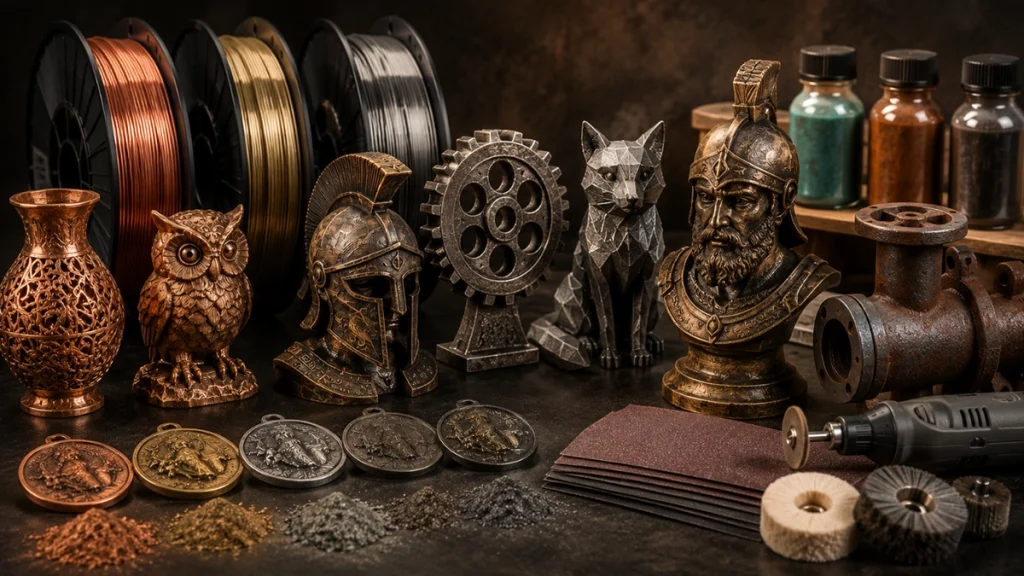
Metal-Fill Filaments: The Look and Feel of Real Metal
What Is Metal Filament?
Metal filament blends PLA with fine metal powders such as copper, brass, bronze, or iron. Unlike metallic-coloured filaments, these materials contain actual metal particles, giving finished prints noticeable weight and a remarkably authentic feel.
Some premium metal filament products contain over 80% metal by weight, making them surprisingly convincing once polished. some premium formulations advertise very high metal content; check product specs.
Printing Considerations
Metal-filled materials print at temperatures similar to PLA but require extra care:
- A hardened steel nozzle is strongly recommended.
- Slower print speeds typically improve results.
- A larger nozzle can help prevent particle-related clogs.
The Real Magic: Post-Processing
Newly printed metal-fill parts often look muted; finishing—sanding, polishing, and patination—reveals their metal-like appearance. The transformation happens during finishing.
Sanding, polishing, and applying patina solutions can create effects that closely resemble cast metal. Copper-filled filaments can even develop a natural verdigris finish, while iron-filled materials can be intentionally rusted for dramatic weathered effects.
Best Uses
- Display models
- Trophies and awards
- Cosplay accessories
- Decorative figurines
- Architectural details
It’s important to remember that these materials are not structural metal replacements. They simply replicate the appearance and feel of metal exceptionally well.
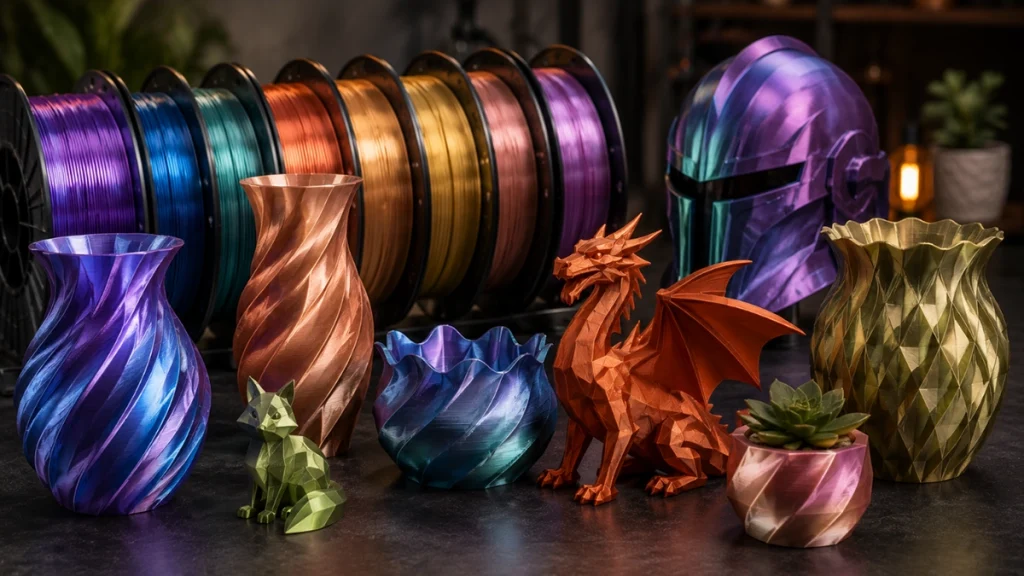
Silk PLA: The Easiest Way to Create Stunning Prints
What Is Silk PLA?
Silk PLA is one of the most popular speciality filaments available today. It uses modified PLA formulations that produce a glossy, satin-like finish straight off the printer.
Available in single colours, dual-colour blends, and even tri-colour variations, silk PLA offers visual impact without requiring extensive post-processing.
Printing Silk PLA
Silk PLA generally prefers slightly higher temperatures than standard PLA, typically between 210°C and 230°C.
For the best results:
- Reduce cooling fan speeds slightly.
- Expect some additional stringing.
- Fine-tune retraction settings.
What to Expect
The biggest advantage of silk PLA is that the finish is already impressive when the print completes. Layer lines often appear less noticeable because the reflective surface naturally disguises them.
Best Uses
- Decorative vases
- Display models
- Cosplay armour
- Gift items
- Art pieces
While visually impressive, silk PLA is usually slightly weaker than standard PLA due to the additives used to create the shine.
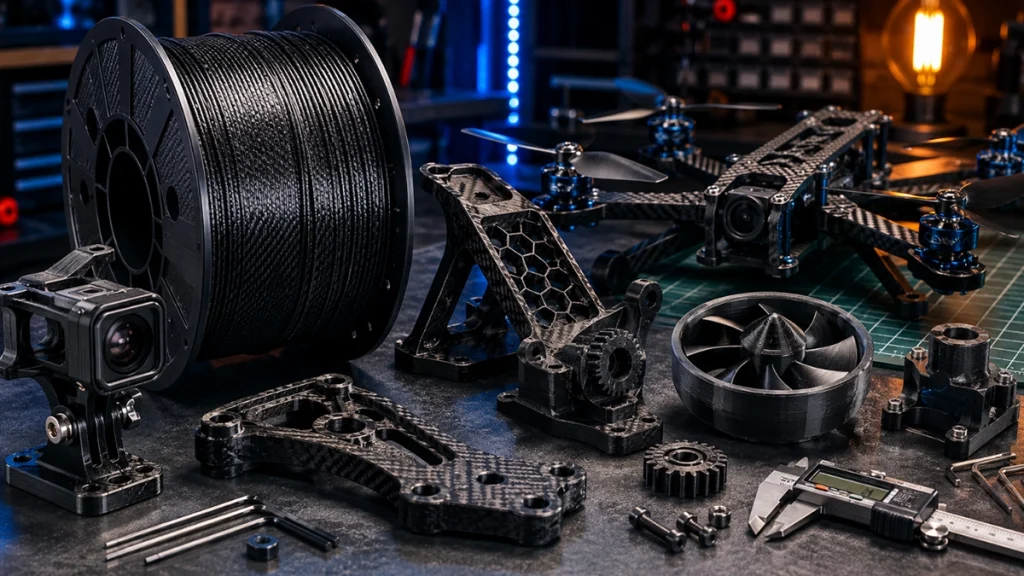
Carbon Fibre Filament: Lightweight and Rigid
What Is Carbon Fibre Filament?
Carbon fibre filament combines a base polymer such as PLA or PETG with chopped carbon fibre strands.
The result is a material that offers increased rigidity, reduced weight, and a distinctive matte finish that many makers love.
Understanding the Benefits
One common misconception is that carbon fibre filament is dramatically stronger than regular filament.
In reality, carbon fibre primarily increases stiffness rather than overall toughness. Parts become more rigid and resist flexing, but they may also become more brittle under sudden impacts.
Printing Requirements
Carbon fibre filament is highly abrasive.
You’ll need:
- A hardened steel nozzle
- Ideally a 0.6mm nozzle or larger
- Dry filament storage to prevent moisture absorption
Best Uses
Carbon fibre materials excel for:
- RC vehicle components
- Drone frames
- Functional prototypes
- Camera mounts
- Jigs and fixtures
For outdoor applications, carbon fibre PETG or ASA is generally preferable to carbon fibre PLA.
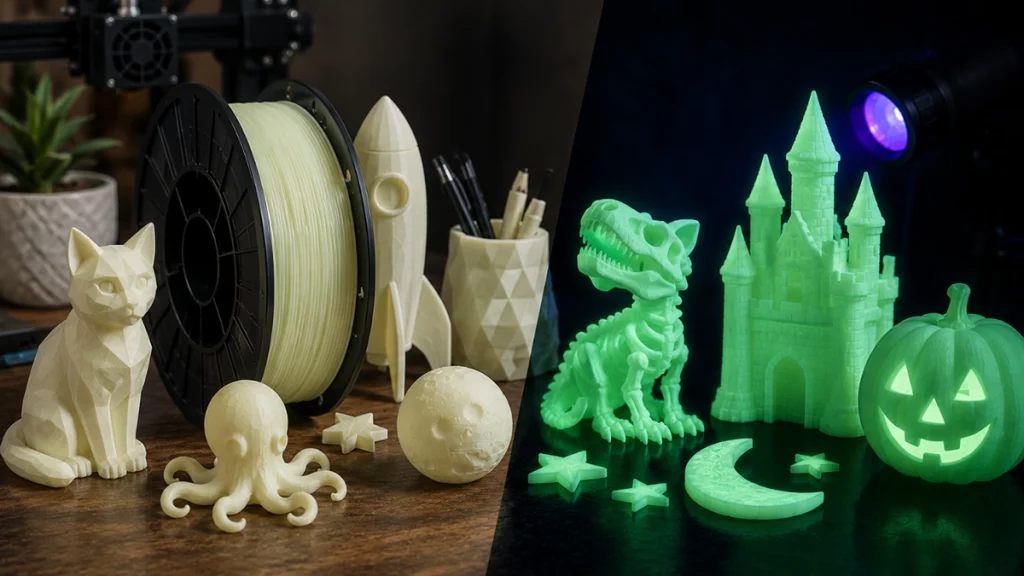
Glow-in-the-Dark Filament: Prints That Shine After Dark
How Does Glow in the Dark Filament Work?
Glow in the dark filament contains phosphorescent compounds that absorb light and slowly release it in darkness.
Modern formulations are significantly brighter and longer-lasting than earlier generations, with green variants typically producing the strongest glow.
Printing Tips
Glow filament prints similarly to standard PLA but includes abrasive particles that can wear brass nozzles over time.
For regular use, a hardened steel nozzle is recommended.
The glow effect can be enhanced by:
- Using thicker walls
- Increasing infill
- Charging prints under UV light
Best Uses
- Decorative models
- Gaming terrain
- Children’s room décor
- Nightlight accessories
- Themed holiday decorations
One thing to remember is that most glow filaments appear pale during daylight hours, with the magic only appearing once the lights go out.
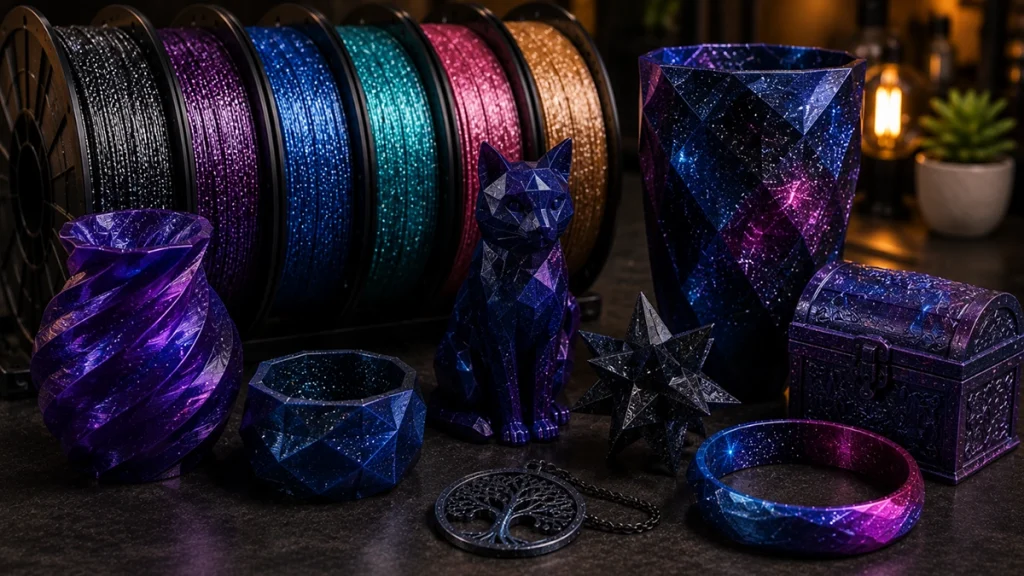
Glitter and Galaxy PLA: Maximum Visual Impact
What Makes Them Different?
Glitter and galaxy filaments incorporate reflective particles and metallic flakes into PLA, creating sparkling finishes that stand out from ordinary prints.
Galaxy filaments often combine dark base colours with shimmering particles, producing an effect reminiscent of a star-filled night sky.
Printing Experience
These materials are among the easiest speciality filaments to work with and usually print much like standard PLA.
Most users can simply load the filament and start printing with minimal adjustments.
Best Uses
- Home décor
- Jewellery
- Cosplay accessories
- Personalised gifts
- Display pieces
Because the glitter effect runs throughout the material, it remains visible even if the surface receives minor scratches.
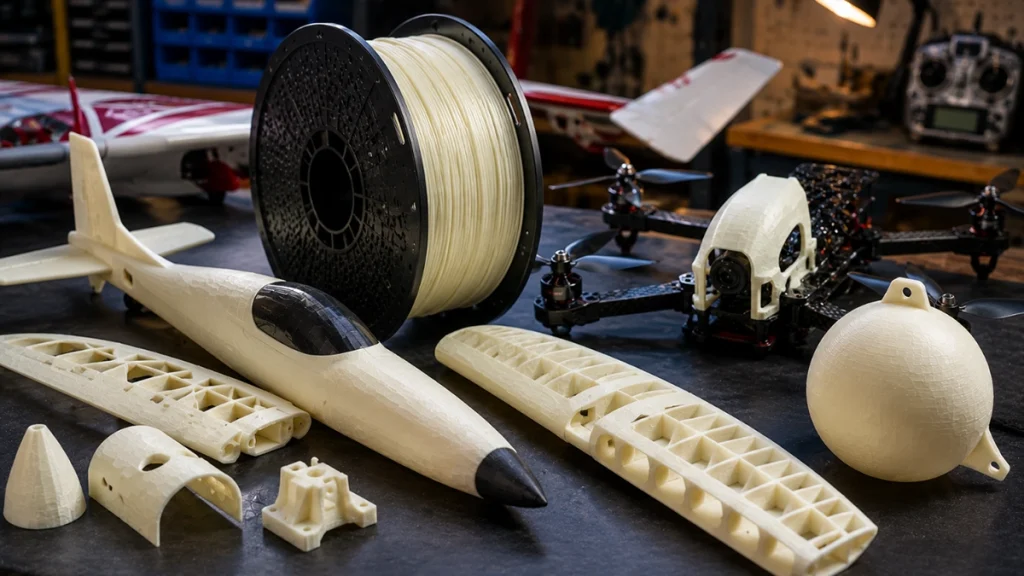
LW-PLA: The Lightweight Specialist
What Is LW-PLA?
LW-PLA, or Lightweight PLA, is unlike any other filament on this list.
When printed at elevated temperatures, it foams as it exits the nozzle, expanding significantly and creating extremely lightweight parts.
The material was originally developed for RC aircraft builders where weight reduction is critical.
Printing LW-PLA
LW-PLA requires careful calibration.
Users typically need to:
- Increase temperatures to 220°C–240°C
- Reduce flow rates dramatically
- Print at slower speeds
- Fine-tune retraction settings
The reward is a print that can weigh up to 65% less than an equivalent standard PLA model.
Best Uses
- RC aircraft
- Drone components
- Buoyancy devices
- Lightweight prototypes
- Weight-sensitive projects
LW-PLA isn’t ideal for parts that require high rigidity, but it excels wherever reducing mass is the priority.
Which Speciality Filament Should You Choose?
The right speciality filament depends entirely on your project goals.
If appearance matters most, wood-fill, silk PLA, metal-fill, and galaxy filaments offer incredible visual results. If performance is your priority, carbon fibre filaments provide enhanced rigidity and reduced weight. For novelty projects, glow-in-the-dark materials create memorable prints that stand out from the crowd.
The key is understanding that every material comes with its own strengths, limitations, and printing requirements.
Final Thoughts
Exploring speciality filaments is one of the most rewarding ways to expand your 3D printing skills. These materials unlock creative possibilities that standard PLA simply can’t match, from realistic wooden textures and polished metal effects to lightweight engineering components and glowing decorative pieces.
Success comes down to preparation. Understanding nozzle requirements, temperature settings, and post-processing techniques will help you avoid frustration and get the most out of every spool.
Don’t forget about safety, especially when post-processing speciality filaments. When sanding, polishing, or finishing filled filaments such as carbon fibre, metal-fill, or wood-fill materials, wear a suitable respirator and work in a well-ventilated area. Fine particles and dust generated during finishing can be harmful if inhaled.
Whether you’re creating functional prototypes, cosplay props, decorative models, or eye-catching display pieces, there’s a speciality filament designed to bring your ideas to life.
Ready to experiment? Explore our range of speciality filaments at 3D Print Lab and discover what your printer is truly capable of.
